
Bilingual AI Training for GCC Businesses: What It Is, Why It Matters, and How to Get Started
If you run a business in the GCC in 2026, you have probably heard that your team needs to start using AI. What nobody is telling you clearly enough is that how your team uses AI matters as much as whether they use it at all.
Most AI tools are built in English. Most AI training programs are delivered in English. And most GCC businesses are implementing AI workflows in English, then translating the outputs into Arabic before they publish, present, or send.
That is the gap. And it is costing businesses across the UAE and Saudi Arabia more than they realize.
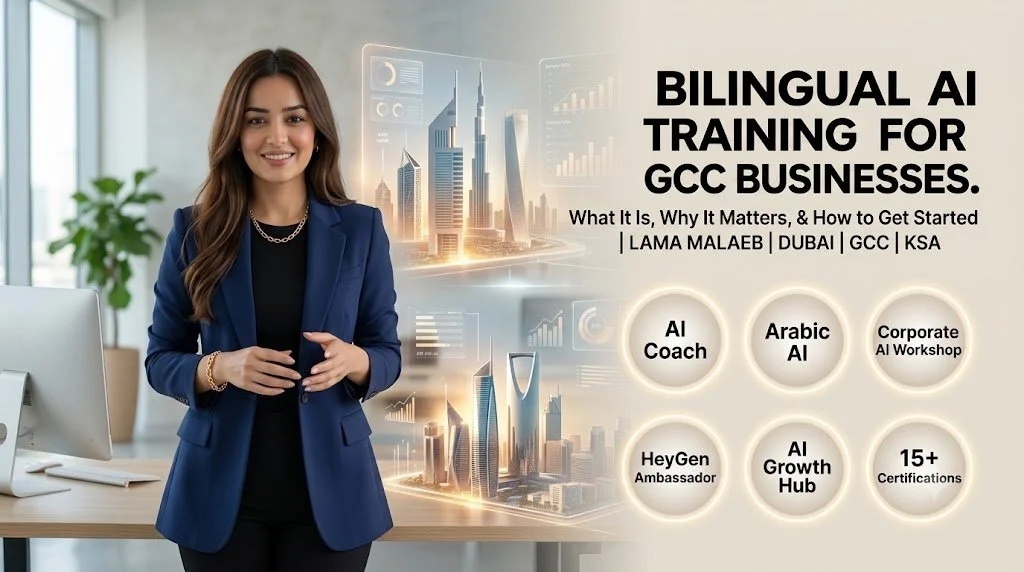
I am Lama Malaeb, a bilingual AI coach and trainer based in Dubai, UAE. I am the founder of AI Growth Hub and an official HeyGen Ambassador. I have spent the last two years working with corporate teams, SME owners, and entrepreneurs across the GCC to implement AI into their workflows in Arabic and English simultaneously. This is what I have learned.
What bilingual AI training actually means
Bilingual AI training is not translation. It is not delivering an English workshop and then handing out Arabic slides. It is building AI workflows that work natively in both languages from the start.
That means prompts written in Arabic that produce Arabic output without losing tone or cultural accuracy. It means AI tools configured to understand the context, register, and nuance that Arabic-speaking GCC audiences expect. It means your team learns to work with AI in the language they think in, not the language the tool was originally trained in.
For a marketing team at a Dubai agency, this looks like building content workflows that produce Arabic captions, Arabic email copy, and Arabic social media scripts without the back-and-forth of translation. For an L&D team at a Saudi corporate, it looks like AI-assisted training materials that work for Arabic-speaking employees from day one.
Why this matters more in 2026 than it did a year ago
The UAE government has announced a target of 295,000 businesses adopting Agentic AI by 2030. Saudi Vision 2030 has workforce AI capability built into its core human development agenda. The pressure on GCC businesses to implement AI is not coming from a trend. It is coming from government strategy.
At the same time, AI tools are becoming more capable of working in Arabic. Claude, ChatGPT, and other large language models have improved significantly in their Arabic language understanding and output quality. The tools are ready. The question is whether your team knows how to use them correctly in an Arabic context.
Most do not. Not because they are not capable, but because every training program they have access to teaches them to use AI in English first and think about Arabic second.
The three most common mistakes GCC businesses make with AI
The first mistake is using English prompts to produce Arabic content. When you prompt an AI model in English and ask it to output in Arabic, you get a translation, not a native Arabic response. The register shifts. The cultural references disappear. Arabic readers notice immediately even when they cannot explain exactly what feels off.
The second mistake is treating AI implementation as a one-time event. A half-day workshop where everyone learns what ChatGPT is does not change how a team works. Real AI adoption requires building workflows into daily operations, with follow-up, practice, and iteration.
The third mistake is choosing tools without considering the bilingual requirement. Not every AI tool handles Arabic equally well. Some tools produce excellent Modern Standard Arabic but struggle with the Gulf and Levantine registers that GCC audiences actually use. Choosing the right tool for your specific audience is a decision that needs to be made before you build any workflow around it.
What bilingual AI training looks like in practice
When I work with a corporate team across the UAE or Saudi Arabia, the process starts with an AI readiness assessment. We look at where the team is currently spending the most time, where Arabic language outputs are required, and which workflows would deliver the fastest results if AI was introduced correctly.
From there, we build. Workshop sessions are delivered in Arabic and English simultaneously. Prompts are written in both languages. Materials are produced bilingually. The team leaves with workflows they can run immediately, in the language they actually work in.
My clients include DEWA, SOCIALEYEZ, and a growing roster of corporate teams and marketing leaders across the Gulf. What they have in common is that they needed AI to work in their actual business context, not a Silicon Valley template adapted for the region.
Who bilingual AI training is for
If your team produces Arabic content regularly, whether that is social media, customer communications, internal documents, or marketing materials, bilingual AI training will deliver faster results than standard AI training.
If you are a CMO or L&D director at a bank, agency, or corporate in the UAE or KSA, and your team is expected to implement AI but does not know where to start in an Arabic context, this is where to start.
If you are an SME owner or entrepreneur in the Gulf running a lean team and needing AI to work in Arabic and English without the overhead of translation, one-on-one coaching will get you there faster than any group course.
How to get started
The fastest way to start is with a 15-minute AI workflow review. We look at one workflow in your business, identify where AI can be introduced bilingually, and map out what the implementation would look like for your team.
From there, options include a full corporate AI workshop delivered in Dubai, Abu Dhabi, or Riyadh, a one-on-one coaching retainer, or joining the AI Growth Hub community on theaigrowthhub.com for ongoing bilingual AI education and resources.
DM AUDIT on LinkedIn or Instagram to book your free 15-minute review, or email hello@lamamalaeb.com with your team size and location.
The GCC AI transformation is happening now, in Arabic and in English. The businesses that build bilingual AI workflows in 2026 will have a significant head start over those that wait.
Author bio
Lama Malaeb is Dubai's bilingual AI coach and trainer. Founder of AI Growth Hub and official HeyGen Ambassador, she delivers Arabic-English AI workshops and coaching for GCC businesses, SMEs, and corporate teams across the UAE and Saudi Arabia. Based in Dubai, UAE. Contact: hello@lamamalaeb.com
